

Search for the product you are looking for
NEWS CENTER
Home / News / Industry News
4 Trillion RMB New Investment in Underground Utility Networks
hitelecom 2024.03.09

On March 9, 2024, during the press conference on livelihood topics at the Second Session of the 14th National People's Congress, Minister of Housing and Urban-Rural Development Ni Hong stated that in 2024, 50,000 old residential communities would be renovated, and a number of complete communities would be constructed. Additionally, over 100,000 kilometers of underground pipelines will be refurbished this year, with the launch of flood and waterlogging control projects in 100 cities, targeting over 1,000 vulnerable points.


At the National Development and Reform Commission (NDRC) press conference on October 8, 2024, it was highlighted that urban development in China has entered a phase focusing both on new constructions and the renovation of existing structures. The task of urban renewal will become increasingly significant, with the renovation of crucial underground infrastructure like gas, water supply and drainage, and heating pipelines as a primary example. Over the next five years, nearly 600,000 kilometers of various types of urban pipelines are expected to be renovated, requiring an estimated investment of about 4 trillion yuan.


Urban underground pipelines, encompassing water supply, drainage, gas, heating, electricity, telecommunications, broadcasting, and industrial pipelines along with their ancillary facilities, cover multiple critical areas and subsystems. They are vital infrastructure and "lifelines" ensuring the functioning of cities. With the ongoing advancement of new urbanization in China, the renovation and upgrading of urban infrastructure, particularly underground pipelines, have garnered attention from the government, enterprises, and the public.


To implement the decisions and arrangements of the Central Committee of the Communist Party and the State Council on "dual focuses" construction, the NDRC and the Ministry of Housing and Urban-Rural Development have jointly issued a directive to compile the "Implementation Plan for the Construction and Renovation of Urban Underground Pipelines and Utility Tunnels." This serves as the basis for applying for central budget funds, ultra-long-term government bonds, and other policy financial supports for future underground pipeline projects.


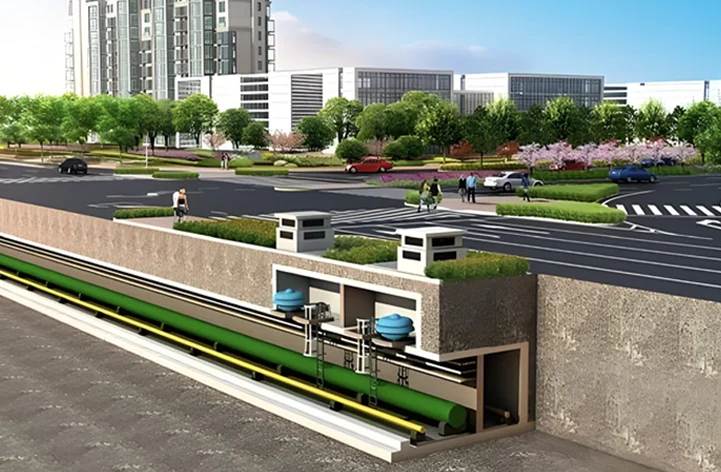
Urban underground utility networks include water supply, drainage, gas, heating, electricity, telecommunications, broadcast television, and industrial pipelines along with their ancillary facilities. These networks are vital infrastructure and "lifelines" essential for the functioning of cities and the well-being of residents. Specifically, urban underground utility engineering encompasses several key areas and subsystems, including but not limited to:


Water Supply Networks

Comprising water pipelines, pumping stations, and reservoirs, responsible for providing clean and safe drinking water to residents and businesses, ensuring stable and reliable water supply.


Drainage Networks

Including stormwater and sewage systems and sewage treatment facilities, responsible for collecting, transporting, and treating urban rainwater and wastewater, ensuring smooth drainage and preventing flood disasters.


Gas Networks

Consisting of gas pipelines, pressure regulating stations, and gas storage facilities, responsible for supplying natural gas and other clean energy sources to residents and businesses, meeting urban energy needs and promoting energy conservation and emission reduction.


Heating Networks

Mainly involving heating pipelines and heating stations, responsible for supplying hot water or steam to residents and businesses, meeting the needs for urban heating and domestic hot water.


Underground Utility Tunnels

Structures and ancillary facilities used to accommodate two or more types of public utility pipelines or specialized pipelines.


2. Policy Support Scope


Special Project for Aging Renovation and Affordable Housing Projects in Urban Gas Pipelines


Aging renovation of communal gas risers and courtyard pipelines and facilities within residential zones.


Replacement of gas rubber hoses and necessary safety devices within households.


Aging renovation of government-owned municipal gas pipelines, stations, and facilities.


Aging renovation of other government-owned or communal urban water supply, drainage, heating pipelines, and facilities within residential zones.


Special Project for Drainage Facility Construction


Strengthening the construction and renovation of drainage networks to gradually eliminate uncovered areas. Renovate drainage networks prone to waterlogging and incorrect stormwater connections. Improve rainwater inlets around flood-prone areas and add rain grates. Construct stormwater detention facilities as appropriate, combining centralized and decentralized approaches.


Construction and renovation of pumping stations for areas with poor drainage due to external water pressure or insufficient pumping capacity. Upgrade or add pumping stations to enhance mechanical drainage. Equip with mobile pumping vehicles and other specialized flood prevention facilities as per emergency plans.


Construction of drainage channels. Conduct rational dredging of rivers, ponds, flood ditches, and roadside ditches to improve flood discharge and drainage capabilities, ensuring compatibility with urban drainage system capacities. Restore naturally covered or filled drainage ditches and rivers due to historical reasons, and create stormwater pathways using secondary roads, green spaces, and grassed swales.


Smart platform construction. Enhance the urban integrated management information platform, install intelligent sensing devices at key points and flood-prone areas of drainage facilities, strengthen real-time data collection and transmission to support daily management, operation scheduling, disaster prediction, early warning, flood control dispatching, and emergency response.


3. Special Project for Pollution Control


Water pollution control and water conservation. Support the construction and renovation of urban sewage collection and treatment facilities, sludge treatment facilities, and urban sewage networks, construction of wastewater resource recovery facilities, desalination projects, and demonstration projects for key materials and equipment.


Ultra-Long-Term Bonds


Construction and renovation of sewage networks within the coverage area of wastewater treatment plants, rectification of river discharge points, and related comprehensive water environment management projects.


Large-scale equipment updates, wastewater treatment, recycling resource utilization, and other municipal infrastructure equipment replacement.

Renovation of aging urban gas pipelines and facilities, urban drainage and flood prevention facilities, aging urban heating pipelines and facilities, and management and renovation of urban water supply network leaks and aging.


4. Work Recommendations


(1) Complete the compilation as soon as possible. Based on past experience, the central budget and ultra-long-term bonds start the application process at the beginning of each year. The pollution control special project for 2025 has already started the application process. Therefore, completing the implementation plan promptly is crucial for applying for funds for 2025 and the next five years.

(2) Ensure high-quality compilation. The effort to secure central policy funds for the next five years and the renovation of urban underground systems involves not only expertise in underground networks but also a deep understanding of various national policies, making high-quality, scientific compilation especially important.


More information that you may be interested in