

In order to deepen the action of enhancing urban safety resilience, promote the construction of digital, networked, and intelligent new urban infrastructure, create resilient cities with strong adaptability and fast recovery speed, and enhance urban risk prevention and governance capabilities, with the approval of the Party Central Committee and the State Council, the following opinions are proposed.
1、 The overall requirements are to adhere to the guidance of Xi Jinping Thought on Socialism with Chinese Characteristics for a New Era, deeply implement the spirit of the 20th National Congress of the Communist Party of China and the 2nd and 3rd Plenary Sessions of the 20th Party Congress, comprehensively implement General Secretary Xi Jinping's important discourse on urban work, adhere to the people-centered development concept, fully and accurately implement the new development concept, coordinate high-quality development and high-level security, adhere to problem oriented and systematic concepts, adhere to government guidance and social participation, adhere to seeking truth from facts and adapting to local conditions, adhere to scientific and technological innovation and digital empowerment, promote the deep integration of new generation information technology and urban infrastructure construction, take information platform construction as the driving force, take intelligent facility construction as the foundation, rely on smart application scenarios, and promote the digital transformation of urban infrastructure, Build an intelligent and efficient new urban infrastructure system, continuously improve the resilience of urban facilities, management, and space, and promote the safe development of cities. The main goal is to achieve significant progress in the construction of new urban infrastructure by 2027, continuously enhance its supporting role in the construction of resilient cities, and form a set of replicable and promotable experience and practices. By 2030, significant achievements will be made in the construction of new urban infrastructure, promoting the construction of a number of high-level resilient cities, continuously improving urban safety resilience, and making urban operations safer, more orderly, smarter, and more efficient.
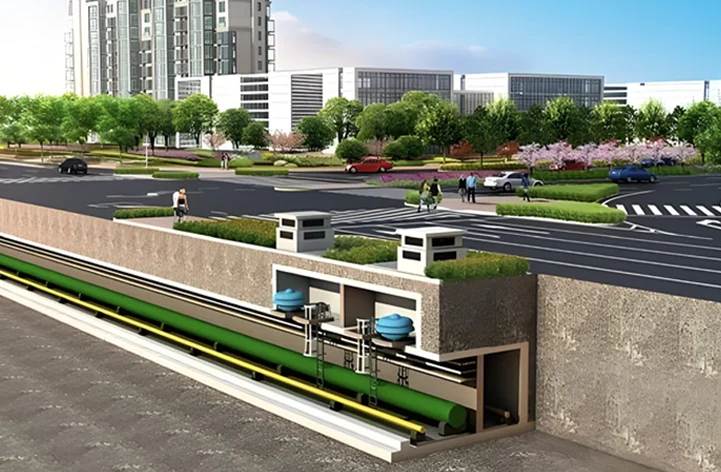
2、 Key task (1) Implement the construction and renovation of intelligent municipal infrastructure. Deepen the survey of municipal infrastructure, establish a dynamic update mechanism for facility information, and comprehensively grasp the current situation and management status. Develop an action plan for the construction and renovation of intelligent municipal infrastructure, and carry out digital transformation, upgrading, and intelligent management of urban water supply, drainage, power supply, gas, heat, fire hydrants (fire cranes), underground comprehensive pipe galleries, and other municipal infrastructure according to local conditions. Accelerate the intelligent transformation of security equipment such as video surveillance in key public areas and roads. Accelerate the construction of urban infrastructure lifeline projects, and the IoT equipment for newly built municipal infrastructure should be designed, constructed, inspected, and put into use synchronously with the main equipment. The intelligent transformation of old facilities should be focused on and promoted comprehensively, gradually realizing real-time monitoring, simulation, scenario construction, rapid assessment, and big data analysis of the operation status of municipal infrastructure, improving the ability to timely warn of safety hazards and respond to accidents, and ensuring the safe operation of municipal infrastructure. Establish a "one map" system for underground pipeline networks that covers a complete range of pipeline categories, accurate basic data, secure data sharing, and fully utilizes data value. Build a basic data platform for the entire process of underground pipeline network planning, construction, operation, and management, and achieve visualized three-dimensional intelligent control of underground pipeline network construction and operation. Strengthen intelligent monitoring of gas leaks, strictly implement pipeline safety supervision and inspection responsibilities, and effectively improve the level of gas and heating safety management. Implement flood prevention and safety protection measures for residents' pressurized storage facilities, strengthen water quality monitoring, and ensure the safety of water supply quality. Strengthen the safety operation monitoring of urban bridges, tunnels and other facilities. Coordinate the pipeline network and water network, flood control and drainage, improve the emergency flood control and coordination mechanism between urban drainage channels, pump stations, gates, drainage pipeline networks and surrounding rivers, lakes, seas, reservoirs, etc., promote the improvement of drainage and flood prevention capabilities of key facilities such as underground facilities, urban rail transit and their connecting channels, and strengthen the flood prevention, anti-theft, and power-off functions of underground parking lots. (2) Promote the coordinated development of smart city infrastructure and intelligent connected vehicles. To support the application of intelligent connected vehicles and improve urban behavior, we aim to establish an integrated perception system for urban roads, buildings, and public facilities. We will deepen the development of "fifth generation mobile communication (5G)+connected vehicles", gradually and steadily promote the application of assisted driving and autonomous driving, accelerate the deployment of intelligent perception systems for urban road infrastructure, and enhance the level of vehicle road coordination. Promote the multi scenario application of intelligent connected vehicles to meet the demand for intelligent transportation. Strengthen the planning, construction, and renovation of urban logistics distribution facilities, and establish an intensive, efficient, and intelligent green distribution system. Accelerate the improvement of emergency logistics system, plan and layout urban emergency material transfer facilities, and enhance the ability to quickly guarantee urban materials in emergency situations. Accelerate the intelligent transformation and construction of parking facilities. Aggregate various types of urban data such as intelligent connected vehicles, intelligent roads, and urban buildings to provide support for intelligent transportation, intelligent parking, urban management, and more.
(3) Developing smart residential areas. Support the integration of conditional residential areas with complete community construction, implement digital, networked, and intelligent transformation and management of public facilities, and improve intelligent security prevention, monitoring and early warning, and emergency response capabilities. Support the layout of self-service terminals such as smart parcel boxes (express boxes) in residential areas. Encourage intelligent services and order maintenance for personnel, vehicles, etc. entering and leaving residential areas. Innovate the intelligent property service model, guide and support property service enterprises to develop online and offline life services. Implement the construction project of embedded service facilities in urban communities to improve the convenience and accessibility of residents' services. Develop smart business districts. Establish a sound digital empowerment and multi-party participation system for residential safety governance, strengthen the prevention and control of hidden dangers such as centralized charging facilities for electric bicycles, fire truck access routes, and safety evacuation systems in residential areas, and enhance the resilience of urban residential areas.
(4) Enhance the level of intelligent management in building construction. Establish a safety management system for the entire life cycle of housing use. Based on the data and base map of the first national comprehensive natural disaster risk survey, we will comprehensively and dynamically grasp the safety hazards of building construction, focusing on investigating safety hazards such as old residential elevators, seismic performance of old building facilities, building fire protection facilities, fire climbing work surfaces, and evacuation routes, and forming a digital archive of building safety hazards. Establish a dynamic update mechanism for housing construction information, strengthen data sharing, and synchronously update the basic information and safety hazard information of housing construction during urban construction and renewal processes. Gradually establish and improve a comprehensive management platform for urban housing construction that covers all aspects, has complete functions, and accurate information. Establish a sound mechanism for eliminating safety hazards in building construction, improve the seismic, lightning, and fire resistance of building construction, and resolutely curb the occurrence of building safety accidents.
(5) Carry out the construction of digital homes. Using residential buildings as carriers, utilizing the Internet of Things, cloud computing, big data, mobile communication, artificial intelligence, and other technologies to achieve interconnectivity between system platforms and home products, accelerating the construction of a unified operating system ecosystem for cross terminal sharing, enhancing the applicability and safety of smart home devices, and meeting the needs of residents for electricity, fire, gas, water safety, environmental and health monitoring. Strengthen the comprehensive cabling of intelligent information, increase investment in the planning and construction of residential information infrastructure, enhance the connectivity of power and information networks, and meet the needs of digital home systems. For newly built fully decorated residential buildings, it is necessary to clarify the basic requirements for setting up intelligent products indoors, and encourage the reservation of conditions for setting up intelligent products such as home abnormal behavior monitoring, emergency calls, and health management. Newly built residential buildings shall be equipped with fiber to the home and mobile communication infrastructure in accordance with relevant standards. Encourage existing residential buildings to adopt smart products similar to newly built ones, and transform traditional home products into electric, digital, and networked ones. In the construction of digital homes, it is necessary to fully respect the personal wishes of residents, strengthen data security and personal privacy protection.
(6) Promote the coordinated development of intelligent construction and building industrialization. Cultivate intelligent construction industry clusters, create an integrated intelligent construction industry system that integrates the entire industry chain, and promote the industrial, digital, and green transformation and upgrading of the construction industry. Deepen the application of Building Information Modeling (BIM) technology to enhance the collaborative level of architectural design, construction, operation, and maintenance. Vigorously develop digital design, intelligent production, and intelligent construction, accelerate the construction of digital design foundation platforms and integrated systems. Promote the intelligent production and upgrading of parts and components. Promote the integration and innovative application of automated construction machinery, construction robots, 3D printing and other related equipment. Promote the construction of smart construction sites, strengthen the deep integration of information technology and construction management, and further enhance the efficiency of safety supervision.
(7) Improve the City Information Model (CIM) platform. Strengthen the open sharing of information in various industries and fields related to national spatial planning, urban construction, surveying and remote sensing, urban operation management, etc., gather three-dimensional data of basic geography, buildings, infrastructure, and various urban operation management data, build urban three-dimensional spatial data models, and improve the informatization level of urban planning, construction, and governance. We will promote the application of urban information modeling platforms according to local conditions, strengthen the integration and coordinated development of functions with other basic spatiotemporal platforms, enrich application scenarios in government services, public health, disaster prevention and reduction, urban physical examination and other fields, carry out comprehensive urban risk assessment, coordinate the use of above ground and underground spaces, reasonably delineate disaster prevention and refuge spaces, provide support for scientifically determining development strategies and risk prevention and control requirements for different risk areas, and improve urban spatial resilience.
(8) Build a comprehensive urban operation management service platform. Strengthen real-time monitoring, dynamic analysis, overall coordination, command and supervision, and comprehensive evaluation of urban operation and management services, and promote the "one network unified management" of urban operation and management services. Accelerate the construction of a three-level platform system at the national, provincial, and city levels, strengthen effective connection with existing platform systems such as urban intelligent centers, and achieve information sharing, hierarchical supervision, and collaborative linkage. Improve the mechanism of urban operation management, strengthen the sharing of urban operation data between the urban operation management service platform and emergency management, industry and information technology, public security, natural resources, ecological environment, transportation, water conservancy, commerce, health, market supervision, meteorology, data management, fire rescue, earthquake and other departments, and enhance the monitoring and early warning capabilities of urban operation safety risks. Carry out normalized comprehensive evaluation of urban operation management services and achieve inter departmental sharing of evaluation results.
(9) Strengthen technological leadership and talent cultivation. Organize research on the basic theory, key technologies, and equipment of new urban infrastructure construction, accelerate breakthroughs in a number of key technologies such as city level massive data processing and storage, multi-source sensor information fusion perception, building information model 3D graphics engine, and building robot applications. Establish and improve technological systems such as information infrastructure data, intelligent road infrastructure, and intelligent construction, and build a new standard system for urban infrastructure. By relying on higher education institutions, research institutions, backbone enterprises, and major scientific research projects, we will increase our efforts in talent cultivation and focus on cultivating compound innovative talents with interdisciplinary knowledge in new generation information technology, engineering construction, urban management, urban safety, and other fields.
(10) Innovative institutional mechanisms. Innovate management methods, models, and concepts, explore the establishment of operational mechanisms and business models for the construction of new urban infrastructure. Innovate and improve investment and financing mechanisms, broaden investment and financing channels, and promote the establishment of a diversified investment and financing system guided by government investment and dominated by enterprise investment. Support eligible new urban infrastructure construction projects through local government special bonds, and encourage policy guidance through incentives instead of subsidies. According to the principles of controllable risk and commercial autonomy, optimize financial service products, encourage financial institutions to increase medium - and long-term credit allocation in a market-oriented manner, and support eligible projects to issue real estate investment trusts (REITs) in the infrastructure sector. Innovate the supply mode of data elements, refine the regulations for data sharing such as urban underground pipelines, and explore the establishment of data sharing, exchange, collaboration, and open models to support the construction of new urban infrastructure. Strengthen the sharing and utilization of data resources across regions, departments, and levels, consolidate the digital foundation of urban construction, operation, and governance, fully rely on the foundation to develop business applications, prevent the formation of data barriers, and avoid redundant construction. Encourage trial and error, actively explore innovation, and timely form replicable and promotable experience and practices.
(11) Ensure network and data security. Strictly implement laws, regulations, and policy standards on network and data security, strengthen the security control of information infrastructure, sensing devices, and smart applications, promote the application of secure and controllable technologies and products, and enhance the security protection of important data resources. Strengthen the resilience of information infrastructure such as network hubs and data centers, establish and improve network and data security emergency systems, enhance network and data security monitoring, reporting and warning, and information sharing, and comprehensively improve the ability of new urban infrastructure to resist security risks. 3、 Strengthen organizational leadership. Under the centralized and unified leadership of the Party Central Committee, all regions and departments should implement the Party's leadership throughout the entire process of promoting the construction of new urban infrastructure and building resilient cities. They should combine actual conditions to ensure the implementation of this opinion and avoid formalism. All relevant departments should take proactive measures, strengthen reform and innovation, and establish and improve collaborative mechanisms. The Ministry of Housing and Urban Rural Development should take the lead in strengthening guidance, summarizing and evaluating, and timely coordinating to solve prominent problems. Promptly report major issues to the Party Central Committee and the State Council in accordance with procedures.