

China Plans Major Upgrades to Urban Underground Utilities
Editor's note: This article is an edited summary of public statements made at two official press conferences in 2024. Figures reflect what was announced at those events; please refer to the official releases for authoritative content.
On March 9, 2024, at the press conference on people's livelihood held during the Second Session of the 14th National People's Congress, Minister of Housing and Urban-Rural Development Ni Hong stated that in 2024 China would renovate 50,000 old urban residential communities, refurbish more than 100,000 kilometers of underground pipelines, and launch flood and waterlogging control projects in 100 cities, targeting more than 1,000 flood-prone locations.
At a National Development and Reform Commission (NDRC) press conference on October 8, 2024, officials noted that urban development in China has entered a phase that emphasizes both new construction and the renewal of existing structures. Taking the renovation of underground infrastructure such as gas, water supply and drainage, and heating pipelines as a primary example, the NDRC estimated that nearly 600,000 kilometers of urban pipelines would be renovated over the following five years, representing an estimated investment of about RMB 4 trillion.
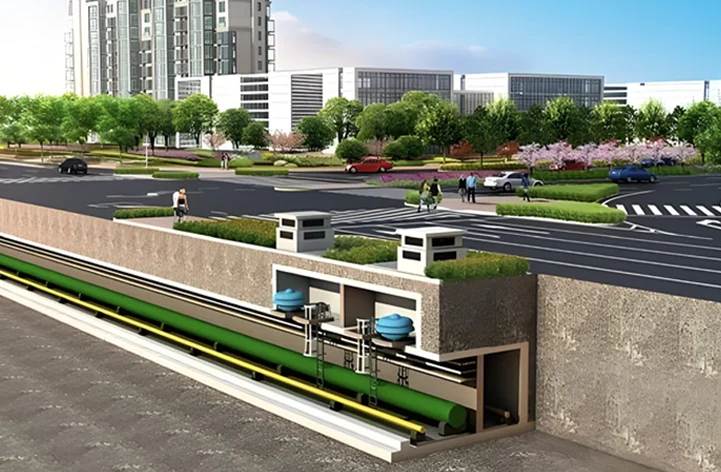
Urban underground utility networks cover water supply, drainage, gas, heating, electricity, telecommunications, broadcasting, and industrial pipelines, together with their ancillary facilities. These networks are vital infrastructure — the "lifelines" that keep cities running and support residents' daily lives — and their renovation has drawn attention from government, enterprises, and the public.
To support this work, the NDRC and the Ministry of Housing and Urban-Rural Development have jointly issued a directive requiring localities to compile an "Implementation Plan for the Construction and Renovation of Urban Underground Pipelines and Utility Tunnels." The plan serves as the basis for applying for central budget funds, ultra-long-term special government bonds, and other policy-based financial support for future underground pipeline projects.
The funding scope relevant to monitoring technology includes drainage facility construction, where supported measures cover the renovation of waterlogging-prone networks, pumping stations and mobile drainage equipment, and stormwater channels, as well as smart platform construction: enhancing urban integrated management information platforms, installing intelligent sensing devices at key drainage points and flood-prone areas, and strengthening real-time data collection and transmission to support daily management, operation scheduling, disaster prediction, early warning, flood-control dispatching, and emergency response.
For the industrial IoT sector, the announced pipeline and drainage programs point to long-term demand for connected sensing — pressure, level, flow, and water-quality monitoring — across municipal networks. Hitelecom will continue to track these programs and develop sensor terminals and monitoring solutions that match their requirements.
Source: Press conference on people's livelihood, Second Session of the 14th National People's Congress (March 9, 2024); National Development and Reform Commission press conference (October 8, 2024). Edited summary by Hitelecom.