

China Issues Guidance on Resilient-City Infrastructure
Editor's note: This article is an edited summary of the "Opinions on Promoting New Urban Infrastructure Construction to Build Resilient Cities," issued by the General Office of the CPC Central Committee and the General Office of the State Council and released in late 2024. It is provided for industry reference and is not an official translation; please refer to the official Chinese text for authoritative content.
The Opinions call for deeper integration of new-generation information technology with urban infrastructure, with the goal of making cities more adaptable to risks and faster to recover from disruptions. By 2027, the construction of new urban infrastructure is expected to show significant progress, with replicable experience formed in supporting resilient-city development. By 2030, the policy aims for a number of high-level resilient cities, with urban operations that are safer, more orderly, smarter, and more efficient.
Intelligent Upgrades of Municipal Infrastructure
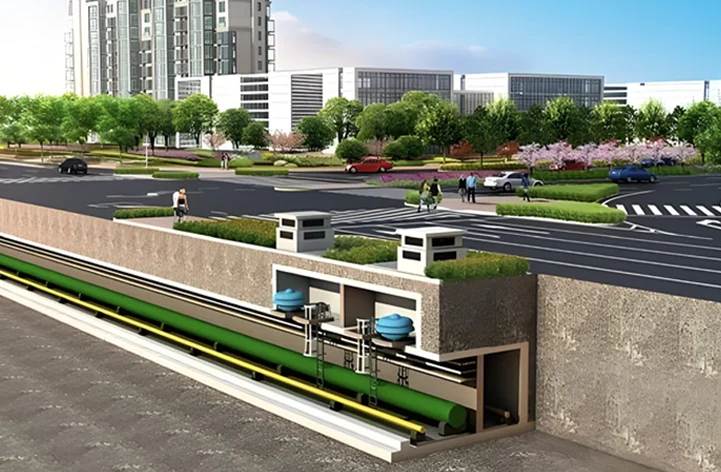
The document directs localities to carry out digital transformation, upgrading, and intelligent management of urban water supply, drainage, power supply, gas, heating, fire hydrants, and underground utility tunnels. For newly built municipal infrastructure, IoT equipment is to be designed, constructed, inspected, and put into use together with the main works, while the intelligent retrofitting of existing facilities is to be promoted comprehensively. The stated objective is to gradually achieve real-time monitoring, simulation, rapid assessment, and big-data analysis of facility operating conditions, improving early warning of safety hazards and emergency response.
Underground Pipeline Data Platforms
The Opinions call for a "one map" system for underground pipeline networks, with complete pipeline categories, accurate base data, and secure data sharing. A basic data platform is to cover the full lifecycle of pipeline network planning, construction, operation, and management, supporting visualized, three-dimensional management of underground assets. The document also requires stronger intelligent monitoring of gas leaks and stricter pipeline safety supervision, together with safety monitoring of urban bridges, tunnels, and related facilities.
Drainage, Flood Control, and Water Supply Safety
Localities are asked to coordinate pipeline networks with water systems and flood-control and drainage facilities, improve emergency coordination among drainage channels, pump stations, gates, and surrounding rivers and reservoirs, and strengthen flood prevention for underground facilities, urban rail transit connections, and underground parking. Water quality monitoring and protection of pressurized storage facilities are also required to safeguard supply quality.
Smart City Infrastructure and Connected Vehicles
The document supports an integrated perception system for urban roads, buildings, and public facilities, deeper development of "5G plus connected vehicles," and the steady application of assisted and autonomous driving, together with intelligent logistics distribution facilities and a comprehensive urban operation management service platform.
What This Means for the IoT Industry
For providers of industrial IoT sensing and monitoring solutions, the policy signals sustained demand for field sensors, communication gateways, and monitoring platforms across gas, water, drainage, bridges, tunnels, and underground utility tunnels. Hitelecom will continue to follow these policy developments and align its product roadmap with the monitoring scenarios they describe.
Source: Xinhua News Agency; General Office of the CPC Central Committee and General Office of the State Council, "Opinions on Promoting New Urban Infrastructure Construction to Build Resilient Cities" (2024). Edited summary by Hitelecom.